Managing a small business often requires managing multiple tasks simultaneously. The workload can feel excessive, encompassing everything from running your business and managing your finances to promoting your products and providing excellent customer service. On top of all of this, it is essential to make sure that your products are delivered to your customers in a safe, timely, and reliable manner.
The good news is that a courier service can help with that. A courier service can do much more for your company than just move packages, even though many business owners only consider them as delivery partners. In fact, working with a trustworthy courier service can have a direct effect on your productivity, financial success, and reputation.
Enhance Productivity and Save Time
For small business owners, time is one of the most valuable resources. Trying to handle daily deliveries in-house can quickly become stressful due to a lack of personnel and resources. Managing deliveries, from scheduling drivers to creating routes, is likely to take up time that could be utilized to develop your company.
You can regain valuable time by hiring a professional courier service to handle your delivery needs. Courier services have the technology, know-how, and efficient systems necessary to guarantee that your goods are picked up, moved, and delivered on time. They can easily handle any size package, no matter how big or small.
This enables you to concentrate on essential tasks like:
Promoting your goods to draw in fresh customers.
improving customer service in order to keep current customers.
Long-term growth requires innovation and planning.
More specifically, courier services allow you to focus your energies on the things that really matter by relieving you from the burden of logistics.
Improve Customer Satisfaction and Brand Reputation
The foundation of any successful small business is satisfied customers. A fantastic product or service by itself is insufficient; the way it is delivered has a significant impact on how consumers view your company.
Here are some ways that a courier service can enhance the reputation of your company:
On-time delivery: Consumers value prompt and accurate delivery of their orders.
Safe product handling: The chance of damage is decreased by careful transportation and appropriate packaging.
Transparency in tracking: A lot of courier services give their clients access to real-time tracking capabilities so they can see the precise location of their packages.
This type of professionalism promotes repeat business in addition to increasing customer trust. A smooth delivery process frequently results in outstanding reviews and positive word-of-mouth referrals, which are effective strategies for creating loyal customers. Think about this: especially in the world of internet shopping, people are more likely to choose a company that offers both products and peace of mind.
Lower the Cost of Shipping
Keeping costs under control is one of the most difficult tasks for small businesses. Although many business owners believe that outsourcing deliveries will be too expensive, cheap parcel delivery services may actually bring in long-term cost savings.
This is the reason:
Large-scale savings: Even if your shipping volumes are small, you can still access competitive pricing as courier services often have partnerships and agreed-upon rates with carriers.
Professional guidance: Couriers can advise you on the most economical shipping routes and options for different areas.
No hidden fleet costs: There are continuous costs associated with operating your own delivery trucks, such as fuel, insurance, driver compensation, and upkeep. These overheads are eliminated through outsourcing.
Increase Visibility and Grow Your Business
Customers might be limited to your immediate neighborhood if you only use in-house delivery. However, a courier service allows you to reach a much wider audience than you currently do.
The majority of expert couriers have extensive networks that span states, cities, and even foreign borders. As a result, your small business can enter new markets without having to worry about complicated logistics. Consider the following possibilities for growth:
Offering your goods to clients nationwide or across states.
exploring international shipping to reach a worldwide audience.
competing with larger companies that already provide extensive delivery choices.
Adjust to Shifting Business Requirements
Rarely do small businesses remain the same. During periods of high demand, your business may grow, or you may introduce new product lines that call for new ways to deliver them. Because courier services are designed to be adaptable, they can readily adjust to these changing needs.
For instance:
Seasonal rises: Couriers can manage the spike in orders during holidays or special sales without sacrificing delivery times.
Urgent Deliveries: Do you need to ship a product today? For urgent circumstances, a lot of couriers provide faster services.
Special needs: Courier services can offer customized solutions for anything from oversized items to fragile items.
No matter how quickly things change, this flexibility guarantees that your company will always be reliable and responsive. You can expand without being limited by delivery logistics when you have a reliable courier partner on your side.
Shipping may seem like just another operational task to many small business owners. However, in practice, it can affect long-term growth, brand perception, and customer relationships. For this reason, working with a reputable courier service is a financially sound choice.
By outsourcing your delivery requirements,
You can save a lot of time and concentrate on expanding your business.
Deliveries that are transparent and quick will satisfy your customers.
Reduce expenses while increasing profitability.
Reach out to new markets.
As your company develops, adapt with ease.
To put it briefly, a professional courier service is about more than just transporting packages; it’s about advancing your company.
Why Choose Teeparam?
Teeparam can assist small business owners in the UK who are searching for a courier service that genuinely understands their needs. Modern technology, adaptable delivery options, and a focus on client satisfaction enable small businesses to optimize processes and deliver outstanding services.
Teeparam is the partner you can rely on, whether you need scalable solutions to support your growth or quick same-day deliveries. Let us take your small business to the next level! Get started by getting in touch with us right now to discover the impact a reputable courier service can have on your company.
In today’s interconnected business world, getting crucial documents across borders isn’t just a nicety—it’s often the lifeline of deals, partnerships, and deadlines. Whether you’re a UK-based firm sealing a contract with an Indian supplier or a global entrepreneur shuttling legal papers between Mumbai and Manchester, in order to send business documents from india to the uk, it demands a blend of precision, patience, and a dash of savvy. I’ve been there myself, back when I coordinated shipments for a small export outfit, and let me tell you: one overlooked customs form can turn a two-day delivery into a two-week headache.
This guide is tailored for you—whether you’re sipping tea in London or navigating the bustling streets of Delhi—aiming to demystify the process for UK audiences familiar with HMRC rules and global players who juggle multiple time zones. We’ll cover everything from regulatory hurdles to practical tips, ensuring your invoices, contracts, or NDAs arrive intact and on time. And if you’re looking for a reliable partner, I’ll spotlight Teeparam Logistics later on; they’ve been a game-changer for many in this space.
Why does this matter now? Post-Brexit, UK import rules have tightened, but trade between India and the UK is booming—bilateral trade hit £38 billion in 2023, per recent figures. Documents like commercial agreements or compliance certificates are the unsung heroes fueling that growth. But mishandle them, and you’re staring down delays, fines, or worse: lost trust. Ready to get your paperwork winging its way across the Arabian Sea? Let’s figure it out. Competitive rates of Teeparam makes Teeparam one of the cheapest parcel delivery in uk
Send Business Documents from India to UK:Customs and Regulations
First things first: documents aren’t “goods” in the traditional sense, but they’re still subject to scrutiny. The UK Border Force and Indian export controls treat business papers as imports, so compliance is non-negotiable. Start with the basics—most documents under £135 in value (about ₹14,000) dodge VAT and duties, but anything pricier might trigger a 20% VAT hit plus customs fees. Are businesses importing regularly? Register for an EORI number (Economic Operators Registration and Identification) via GOV.UK—it’s free and takes minutes online.
From the Indian side, you’ll need to adhere to the Foreign Trade Policy. Prohibited items? Steer clear of anything sensitive: no controlled substances, weapons, or even certain seeds tucked into envelopes (yes, really). Documents like passports or birth certificates are restricted—use official channels instead. For standard business fare—invoices, contracts, audit reports—the green light is usually straightforward.
Key paperwork includes:
Commercial Invoice: Detail the contents, value, and purpose. Even if it’s just paper, assign a nominal value (say, £10) to cover bases.
Packing List: Simple inventory—e.g., “5 sheets of A4, confidential contract.”
Air Waybill or Bill of Lading: Provided by your courier; it’s your tracking lifeline.
Certificate of Origin: If your docs tie into trade deals, this proves Indian provenance and might snag you tariff perks.
Brexit added a wrinkle: No more seamless EU routing, so expect electronic declarations via the UK’s CDS (Customs Declaration Service). Tools like the GOV.UK Trade Tariff calculator helps estimate costs upfront. And remember, endorsements like “No commercial value—documents only” on the envelope can fast-track clearance.
Picking Your Shipping Method: Air, Courier, or Something Else?
Options abound, but for business documents, speed trumps all. Sea freight? Forget it—that’s for bulk spices, not urgent memos. Why courier? Tracking in real-time, insurance up to £5,000, and dedicated customs brokers who handle the legwork. For eco-conscious UK firms, many now offer carbon-neutral offsets. But here’s the rub: Not all couriers are created equal. If your docs involve sensitive data (think IP agreements), opt for ones with GDPR-compliant handling.
For global reach, consider hybrid services blending air and ground. And if you’re shipping frequently, negotiate volume rates—I’ve seen them slash costs by 20%. Pro tip: Weigh your envelope early; over 2kg, and prices spike.
Step-by-Step: Your Roadmap to Seamless Shipment
Alright, sleeves rolled up—here’s the playbook, honed from trial and error.
Step 1: Prep Your Documents
Scan and back up digitally—always. Use acid-free paper to prevent yellowing, and avoid staples if possible (they snag scanners). For confidentiality, seal in tamper-evident envelopes. If originals are irreplaceable, send certified copies.
Step 2: Choose and Book Your Service
Head to your courier’s site or app. Input origin (e.g., Delhi), destination (London postcode), weight (documents rarely exceed 1kg), and urgency. Get quotes—expect £20-£50 for express. Book online for discounts; many offer pick-up from your office.
Step 3: Package Like a Pro
Sturdy, padded envelopes are king—think Tyvek for waterproofing. Label clearly: Sender’s full address and contact on one side, recipient’s on the other. Add “Fragile—Documents” and your phone number. Inside, include a cover letter recapping the contents for customs.
Step 4: Tackle Customs Declarations
Fill CN22/CN23 forms (for postal) or digital equivalents. Be honest—under-declare, and risk seizure. Mark as “Documents for business use—low value.” If exporting from India, get an IEC (Importer Exporter Code) if you’re a regular; it’s a one-time ₹500 affair.
Step 5: Ship and Track
Drop off or schedule pick-up. Pay duties upfront if flagged (couriers often advance and bill you). Track obsessively via app—delays often stem from incomplete info, not the service itself.
Step 6: Receive and Follow Up
Your UK recipient might need to pay minimal fees; prep them. Once delivered, confirm receipt and shred proofs if needed.
This sequence shaved days off my old routine. For global, adapt for local holidays—Diwali or Christmas can bottleneck ports.
Budgeting Time and Money: What to Expect
Timelines? Express couriers nail 2-3 days to major UK hubs like London or Birmingham; 4-5 days for remote spots. Economy? 7-10 days, but why risk it for board reports?
Costs vary: A 500g envelope via DHL might run £25 (₹2,600), including fuel surcharges. Add £5-10 for insurance. Frequent shippers bundle via subscriptions for 15% off. Hidden fees? Customs brokerage (£10-20) or GST on Indian-side services (18%). Use calculators on courier sites for precision—input your exacts for spot-on quotes.
In my experience, investing in speed pays dividends; a delayed contract cost one firm £10k in penalties. Globally, factor currency fluctuations—pound strong? Hedge with multi-currency accounts.
Why Teeparam Logistics Deserves a Shout-Out
Amid the giants, independents like Teeparam Logistics shine for personalized touch. Specializing in India to UK parcel service routes, their document service handles everything from notarized deeds to tender bids with white-glove care—think dedicated handlers and 24/7 support. Delivery? Often 2-4 days, with real-time tracking via WhatsApp alerts, perfect for jet-lagged execs.
Their broader courier arm extends to parcels but excels at docs, offering competitive rates (starting ~₹2,000/kg) and eco-packaging. What sets them apart? Tailored advice for SMEs— they’ve navigated Brexit quirks for countless exporters, minimizing hold-ups. A client once raved about their customs wizardry saving a shipment from quarantine. If reliability’s your jam, Teeparam is your ally—book a quote today and feel the difference.
Pitfalls to Dodge and Pro Tips for Smooth Sailing
Common traps? Overpacking (bulks up weight fees) or vague descriptions (“papers” vs. “business contract”). Tip: Use online apps for multi-carrier booking. For security, encrypt scans and opt for signature-proof delivery.
Eco-angle for UK readers: Choose carbon-offset services; it’s a nod to net-zero goals. Globals, localize—UK postcodes are precise, but Indian PINs need full street details.
Sustainability aside, ensure always—lost docs can torpedo deals. And chat with recipients; time zones mean a 9 am Delhi dispatch lands at 4:30 am GMT.
Wrapping It Up: Cross That Channel with Confidence
Sending business documents from India to the UK isn’t rocket science—it’s about foresight and the right tools. Follow these steps, lean on pros like Teeparam, and you’ll turn potential snags into seamless successes. In a world where deals close via email but seal via post, staying ahead means your business thrives. Got a shipment queued? Start today—your UK partners are waiting.
With Teeparam there are other services which includes international money transfer, currency exchange, air ticket booking. Teeparam Exchange also offers competitive rates so that you can get more money while you send money to Sri Lanka.
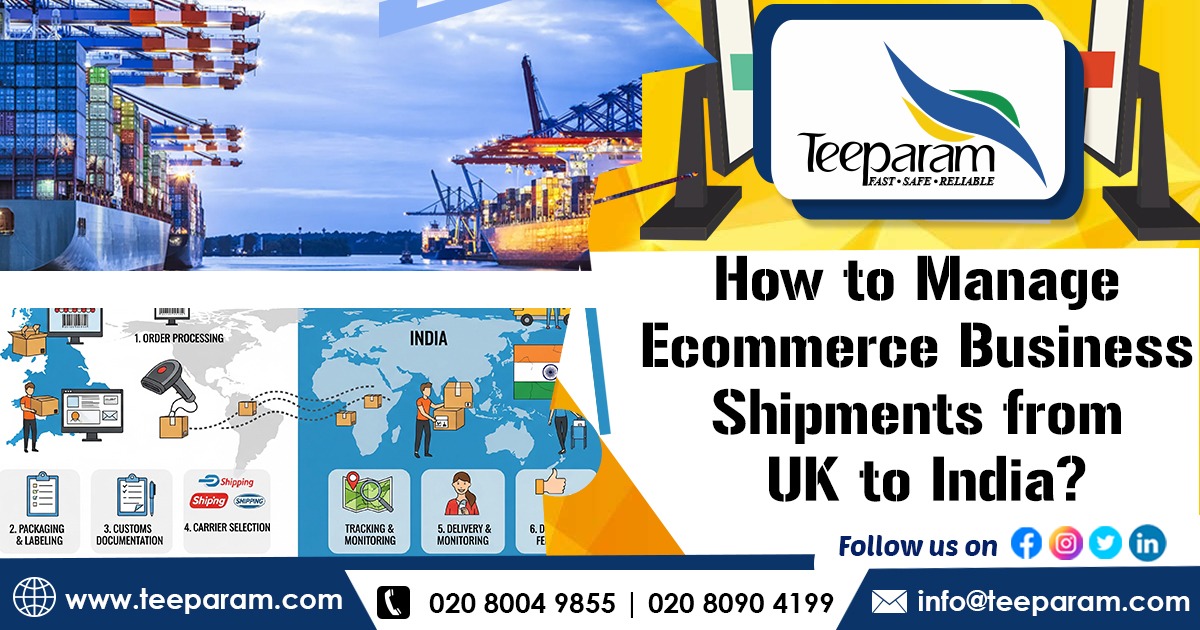
E-commerce companies heavily depend on trusted and effective shipping to thrive in today’s rapidly evolving digital economy. Online sellers seeking to expand their customer base in India must have a well-managed shipping strategy. E-commerce companies need to learn how to manage shipments efficiently and economically as more Indian customers shop online for goods from abroad.
To develop a proper plan and budget, e-commerce sellers need to understand the factors that influence shipping costs. Among the main factors are:
Package Dimensions and Weight
Shipping costs are calculated using the parcel’s actual weight or volumetric weight, whichever is greater. Volumetric weight takes into account the package size, considering that large but lightweight packages do not get overcharged. E-commerce sellers should concentrate on cutting back the extra packaging to save money.
Speed of Delivery
Faster deliveries cost more than a standard delivery. It is important to match shipping speeds with customer needs. Some clients will prefer to wait a few more days rather than pay a higher rate for shipping.
Additional Services
Insurance, real-time tracking, and signature confirmation are some of the important add-ons. Even though they slightly put up the price, they are essential for safeguarding expensive e-commerce items like luxury goods, fashion items, and electronics.
Seasonal Variations
Holiday seasons or major sales events can increase the shipping costs due to the high demand. To prevent delays and extra costs, E-commerce companies should plan their shipments ahead of time.
Selecting the Best Courier Service for Deliveries in E-Commerce
One of the most important steps in handling shipments from online retailers is choosing a suitable courier partner. Businesses should evaluate couriers based on the following criteria when shipping packages to India:
Time of Delivery: Think about the speed at which you would like your clients to receive their orders. Express services are more expensive but faster.
Tracking Features: Both the buyer and the seller can follow the shipment’s path with accurate tracking.
Options for insurance: Guards against damage or loss of priceless or delicate goods.
Customs Support: Customs clearance goes more smoothly when couriers assist with paperwork.
Flexibility in Pickup and Delivery: Door-to-door services, particularly for small and medium-sized businesses, save time and effort.
By working with a courier partner like Teeparam Logistics, businesses benefit from low cost, better speed, and reliability. They will ensure a smoother shipping experience for both sellers and customers.
How to reduce costs in E-commerce Shipping
Online businesses must control expenses without compromising their quality of service. Here are a few tried-and-true methods:
1. Make a plan
Prepare ahead of time to avoid last-minute express shipments. You can select standard, economical delivery options with scheduled shipping.
2. Enhance Packaging
Reduce volumetric weight charges by using packaging that is the proper size. Always use sturdy yet lightweight materials to protect the items without raising shipping costs.
3. Look for Shipping Choices
Never accept just one quote. Search for a variety of options that can enable you to choose the one that best suits your needs in terms of delivery expectations and budget.
4. Consider Bulk Shipping
When shipping several orders to India, it’s usually less expensive to ship them all at once rather than sending each package separately.
Make Use of Digital Tools
Nowadays, many logistics companies offer digital platforms that simplify price comparison, shipment tracking, and document management—all in one location.
Understanding the Customs rules and regulations for UK-to-India Shipments
For many e-commerce businesses, the most challenging part of international shipping is customs clearance. Documentation errors can lead to additional fees or delays. E-commerce vendors need to be aware of:
Accuracy in Documentation
A commercial invoice, packing list, and accurate product information must be included with every shipment.
Items That Are Prohibited and Restricted
Some products may need permits to be shipped into India, while others are prohibited. Before shipping, sellers must review the most recent list of prohibited items.
Taxes and Duties
Depending on the value of the shipment and the type of product, recipients in India might be required to pay customs taxes or duties. Gaining customers’ trust requires being open and honest about these costs.
4. HS Codes
HS codes provide the customs duty and tax applicable for various products, and the correct Harmonized System (HS) codes are essential.
How Teeparam Logistics Can Support E-commerce Businesses in the UK
A logistics partner that not only handles shipping but also streamlines the entire process can be very helpful to e-commerce sellers. Teeparam Logistics provides value in the following ways:
1. Reasonably priced and adaptable options
Teeparam Logistics helps companies increase profits while maintaining customer satisfaction by providing affordable solutions that are suited to various shipment sizes and speeds.
2. Tracking in Real Time
Consumers expect to constantly know the status of their orders. Teeparam Logistics gives buyers and sellers peace of mind by providing dependable tracking updates.
3. Easy Clearance of Customs
Teeparam Logistics lowers the possibility of delays at Indian customs by helping with documentation and compliance.
4. Insurance for Peace of Mind
Sellers can ship valuable goods with confidence, knowing they are covered against potential losses thanks to built-in insurance options.
Complete Support
Teeparam Logistics reduces the hassle for e-commerce companies by providing door-to-door service from pickup in the UK to delivery in India.
Digital Efficiency
Teeparam Logistics saves e-commerce sellers a great deal of time by enabling automated documentation, quote comparisons, and shipment management through its digital logistics platform. At a glance, it might look difficult to manage e-commerce shipments from the UK to India, but it is quite easy with the correct preparation and logistics assistance. Businesses can speed up their international deliveries by understanding cost factors, making plans, optimizing packaging, and successfully dealing with customs.
With competitive prices, real-time tracking, customs assistance, and end-to-end service, Teeparam Logistics stands out as a trustworthy partner for online retailers. UK companies can enter the Indian market with confidence thanks to their experience, delivering goods fast and satisfying customers.
Many companies in today’s globalised economy depend on importing and exporting goods. New business opportunities, expanded consumer reach, and fascinating markets are all made possible by international trade. Shipping a package across countries isn’t as easy as sending goods across town. Complicated regulations, a ton of paperwork, and logistical difficulties can quickly overwhelm your company. Freight forwarders can help with that.
Your behind-the-scenes logistics specialist, a freight forwarder, ensures that your goods arrive at their destination promptly, safely, and legally. Working with a freight forwarder can help you save time, money, and risks in your global supply chain, regardless of how big or small your company is.
A Freight Forwarder: What Is It?
A business that specialises in planning the transportation and storage of goods for companies is known as a freight forwarder. Consider them as your cargo’s travel agents. They plan and coordinate every stage of the journey in collaboration with carriers, such as trucking companies, ocean shipping lines, rail operators, and airlines, rather than moving the goods themselves.
Among the many services provided by freight forwarders are:
Making travel arrangements via rail, road, sea, or air
Overseeing cargo storage and warehousing
Getting export and import paperwork ready and submitting it
Managing duties and customs clearance
Providing insurance for cargo
Monitoring shipments and keeping customers informed
Advising on the most economical shipping routes
What Is the Real Job of a Freight Forwarder?
International shipping is more difficult than it seems. Every nation has its laws, taxes, and documentation requirements. Selecting the incorrect shipping option or omitting a form can lead to costly delays or even the seizure of your goods at the border.
From the beginning to the end, freight forwarders handle everything. They simplify your life in the following ways:
They Make the Best Route Plans
To determine the most efficient method of shipping your goods, freight forwarders collaborate with a number of carriers. They take into account factors like cost, delivery time, reliability, and any unique needs your shipment may have.
They Make Transportation Reservations
A freight forwarder arranges the transportation, whether it be by road, rail, sea, or air, after the optimal route has been determined. To ensure that your goods arrive at their destination on schedule, they might even combine all four.
They Take Care of the Documentation
Bills of lading, customs declarations, commercial invoices, certificates of origin, and other paperwork are all part of international shipping. To prevent delays or legal issues, a freight forwarder makes sure that all paperwork is completed accurately.
They Address Customs
Freight forwarders are knowledgeable about various nations’ customs regulations. They assist in making sure your products meet those regulations, paying the required taxes, and preventing penalties or delays.
They Provide Extra Services
Do you require storage? Storage with temperature control? Cargo insurance? A variety of value-added services are provided by freight forwarders to ensure a smooth shipping experience.
The importance of a Freight Forwarder
Let’s examine the advantages of working with a freight forwarder.
Save time and concentrate on your business.
International logistics management requires experience and patience. You probably lack the resources to deal with customs regulations, carrier reservations, and rate negotiations if you’re just trying to expand your company. You can concentrate on sales, customer support, and product development by having freight forwarders take care of all that.
Keep out of costly errors
Minor mistakes in documentation or shipping choices can result in significant losses. A customer may become upset if a shipment is delayed. Your goods could be detained at the border if a customs form is missing. Freight forwarders are experienced enough to steer clear of common blunders that could harm your reputation or cost you money.
Consult an Expert
The particulars of international shipping are well-known to freight forwarders. They are aware of import taxes, local holidays, peak seasons, and how to handle expensive or delicate goods. Their knowledge helps in decision-making and keeps you ahead of future challenges.
Make the Most of Present Relationships
Freight forwarders already maintain connections with reliable agents and carriers worldwide. Compared to shipping alone, this enables them to bargain for lower prices, reserve space more quickly, and address issues more effectively.
Ensure Compliance
Every nation has its laws. It can be overwhelming to try to comprehend them all by yourself. In order to prevent legal issues and delivery delays, freight forwarders ensure that your shipment conforms with international trade laws.
Who Needs to Use a Freight Forwarder?
A freight forwarder is your best friend if your company ships internationally. This comprises:
Online retailers that ship internationally
Manufacturers importing components or raw materials
Retailers who purchase goods from overseas vendors
Distributors who export completed goods
New businesses introducing international product lines
Having a skilled freight forwarder on your side can streamline the process and guarantee your goods arrive without any problems, even if you only ship occasionally.
Work with Teeparam Logistics and Leave It to the Professionals
For many years, Teeparam Logistics has assisted companies in thriving in international trade. We offer full-service freight forwarding, which includes:
Land transportation, rail, sea, and air transportation
Clearance of customs
Storage of cargo and warehousing
Tracking and insurance
Customised shipping plans
For seamless door-to-door delivery of your goods, we collaborate with many reputable logistics companies. A committed account executive who is familiar with your company will assist you in developing a personalised shipping strategy when you work with us.
International shipping means lots of documentation and a bit of a lengthy procedure that can be time-consuming, but it doesn’t have to be. A trustworthy freight forwarder can take care of the hassles for you, allowing your company to expand internationally without any problems. Freight forwarders handle every aspect, from paperwork to customs, saving you stress, money, and time.
Teeparam Logistics can assist you if you’re searching for a reliable goods forwarding partner. Contact us now to ship more intelligently and let us take the guesswork out of international shipping.
In the world of sea cargo, where massive ships crisscross oceans carrying everything from electronics to raw materials, documentation might seem like a mundane detail. Yet, it’s the backbone of the entire operation. Without proper paperwork, cargo doesn’t move, ports grind to a halt, and businesses lose money. Documentation in sea cargo isn’t just about filling out forms—it’s about ensuring trust, compliance, and efficiency in a complex global supply chain. This article explores why documentation is so critical, how it impacts the maritime shipping industry, and why getting it right matters more than ever.
The Role of Documentation in Sea Cargo
Sea cargo to Sri Lanka involves moving goods across international borders, often spanning multiple countries, legal systems,sea cargosea cargo and regulatory bodies. Documentation serves as the universal language that keeps this process running smoothly. It’s the proof that goods are what they claim to be, that they’re being shipped legally, and that all parties involved—shippers, carriers, and receivers—are on the same page.
At its core, documentation provides clarity. A single shipment might require dozens of documents, including bills of lading, commercial invoices, packing lists, certificates of origin, and customs declarations. Each of these serves a specific purpose, from proving ownership to ensuring compliance with international trade laws. For example, a bill of lading acts as a contract between the shipper and the carrier, a receipt for the goods, and a document of title that can be used to transfer ownership. Without it, cargo could be stuck in a port, racking up storage fees or even being seized.
Documentation also mitigates risk. In an industry where goods worth millions are entrusted to third parties, paperwork establishes accountability. It ensures that everyone knows who’s responsible if something goes wrong—whether it’s a lost container, damaged goods, or a customs violation. In short, documentation is the glue that holds the sea cargo industry together.
Key Documents in Sea Cargo
To understand the importance of documentation, it’s worth looking at some of the key documents involved in sea cargo and their roles:
Bill of Lading (B/L): Often called the most important document in shipping, the B/L serves three purposes: it’s a contract of carriage, a receipt for the goods, and a document of title. It details the type, quantity, and destination of the cargo, ensuring all parties agree on what’s being shipped and where it’s going.
Commercial Invoice: This document provides a detailed breakdown of the goods, including their value, description, and terms of sale. It’s critical for customs clearance and determining duties or taxes.
Packing List: A packing list specifies the contents of each package or container, including weights, dimensions, and handling instructions. It helps port workers and customs officials verify the cargo without opening every box.
Certificate of Origin: This certifies where the goods were made, which is crucial for complying with trade agreements and tariffs. For instance, goods from certain countries might qualify for lower duties under specific trade pacts.
Customs Declaration: This document provides information to customs authorities about the shipment’s contents, value, and compliance with local regulations. Errors here can lead to delays, fines, or even seizure of goods.
Each of these documents must be accurate, complete, and submitted on time. A single typo or missing signature can cause a shipment to be held up, costing businesses time and money.
Why Accuracy Matters
In sea cargo, accuracy in documentation is non-negotiable. A small mistake—like a wrong weight measurement or an incorrect Harmonized System (HS) code—can lead to serious consequences. Customs authorities rely on these documents to assess duties, ensure compliance with trade laws, and prevent illegal activities like smuggling. If something doesn’t add up, they won’t hesitate to delay or reject a shipment.
For example, imagine a shipment of electronics arriving at a port with a commercial invoice listing an incorrect value. Customs officials might suspect undervaluation to evade taxes, leading to an audit or seizure. The shipper could face fines, and the cargo might sit in limbo for weeks. In 2022, the World Customs Organization reported that documentation errors were a leading cause of delays in global trade, affecting nearly 30% of shipments.
Accuracy also builds trust. When documentation is clear and correct, it reassures all parties—shippers, carriers, consignees, and regulators—that the shipment is legitimate. This trust is especially critical in international trade, where parties often don’t know each other personally and rely on paperwork to establish credibility.
The Cost of Poor Documentation
The consequences of inadequate documentation go beyond delays. They can hit businesses where it hurts most: their bottom line. Storage fees, known as demurrage and detention charges, can pile up quickly when cargo is stuck at a port. For instance, a container held up for a week could incur thousands of dollars in fees, depending on the port and carrier.
Fines are another risk. Customs authorities in many countries impose hefty penalties for non-compliance, such as incorrect or incomplete documentation. In severe cases, goods can be confiscated, or businesses may face legal action. For small and medium-sized enterprises, these costs can be devastating.
Poor documentation also damages relationships. A shipper who consistently provides inaccurate paperwork risks losing the trust of carriers, freight forwarders, and customers. In an industry built on reliability, this can lead to lost contracts and reputational harm.
The Role of Technology in Streamlining Documentation
Thankfully, technology is making documentation easier and more reliable. Digital platforms like blockchain-based systems and electronic data interchange (EDI) are transforming how documents are created, shared, and verified. For example, blockchain ensures that documents like bills of lading are tamper-proof and instantly accessible to all parties, reducing the risk of fraud or errors.
Many ports and shipping companies now use electronic platforms to submit and process documents. The Port of Rotterdam, one of the world’s busiest, has adopted a fully digital system called Portbase, which allows shippers to submit documents online, cutting down on paperwork and speeding up clearance. According to a 2023 report by the International Maritime Organization, digital documentation has reduced processing times at major ports by up to 40%.
Automation is another game-changer. Software tools can cross-check documents for errors, generate standardized forms, and ensure compliance with international regulations. These tools are especially valuable for small businesses that may lack the resources to hire dedicated documentation specialists.
However, technology isn’t a cure-all. Human oversight is still essential to ensure that data entered into these systems is accurate. A computer can’t catch every mistake, especially if the error stems from incorrect information provided by a supplier or shipper.
Challenges in Documentation
Despite advances in technology, documentation in sea cargo remains challenging. One major issue is the sheer complexity of international trade regulations. Each country has its own rules, and what’s acceptable in one port might not fly in another. For example, the European Union has strict requirements for certificates of origin, while some Asian countries demand additional sanitary certificates for agricultural goods.
Language barriers also complicate things. Documents often need to be translated or presented in multiple languages, increasing the risk of errors. Cultural differences in how businesses handle paperwork can further muddy the waters.
Another challenge is coordination. A single shipment involves multiple parties—shippers, freight forwarders, carriers, customs brokers, and port authorities all of whom need access to the same documents. Miscommunication or delays in
Smooth Seas, Seamless Docs: Teeparam Logistics Delivers with Care
Teeparam Logistics stands out as a trusted partner in sea freight, delivering exceptional service with a customer-centric approach. Their expertise in handling Full Container Load (FCL), Less-than-Container Load (LCL), and Conventional Load shipments ensures timely, secure, and cost-effective delivery. What truly sets Teeparam apart is its friendly, responsive team, which simplifies the complexities of documentation, ensuring accuracy and compliance with international regulations. With 24/7 support and advanced tracking systems, Teeparam makes the documentation process seamless, giving you peace of mind. Choose Teeparam Logistics for reliable, hassle-free sea freight services backed by outstanding customer care.