 United KingdomIndiaSri Lanka


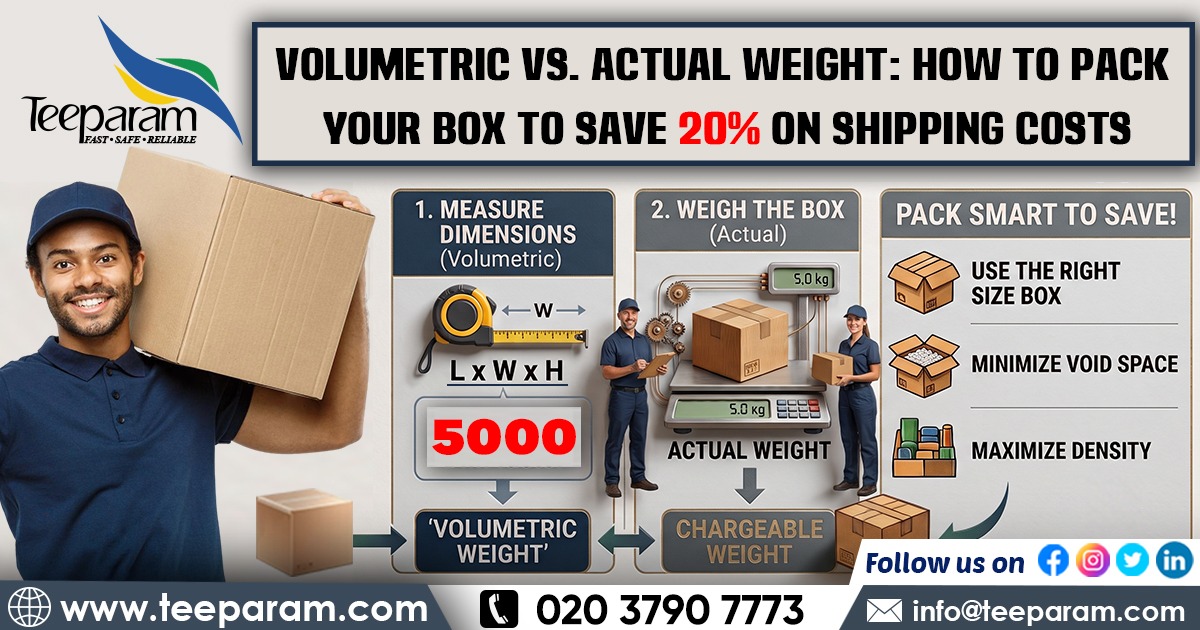
If you’ve ever been shocked by international courier charges from the Sri Lanka to anywhere in the world, you’re not alone. Many have learned this lesson the hard way by sending packages abroad. Sometimes the box you need to ship may weigh just 2 kilograms, but you will be charged for 5 kilograms. Isn’t this Confusing and frustrating? What happens when you call the courier company? They will blame it on the “Volumetric Weight.”
Understanding the difference between volumetric weight vs actual weight can literally save you hundreds of pounds annually if you ship regularly.
What Exactly Is Volumetric Weight?
Think of volumetric weight as the space your package occupies in the delivery van. Courier companies can’t just consider how heavy your box is—they also need to think about how much room it takes up. After all, a van full of lightweight pillows and a van full of books might weigh the same, but you can fit far more books in the same space.
Volumetric weight (also called dimensional weight) is calculated using a simple formula:
Length × Width × Height (in centimeters) ÷ 5000 = Volumetric Weight in kilograms
Different carriers might use slightly different divisors, but 5000 is the standard for most international shipments. When you use a shipping cost calculator, it typically compares both your package’s actual weight and its volumetric weight, then charges you based on whichever is higher.
The Real Impact on Your Wallet
Here is a real example. Say you’re shipping a box of children’s clothes from Colombo to Coventry. The box measures 40cm × 30cm × 25cm and weighs 3kg.
Your volumetric weight would be: 40 × 30 × 25 ÷ 5000 = 6kg
Even though your package actually weighs just 3kg, you’ll be charged for 6kg. If the international courier charges from the UK to Canada are £8 per kilogram, you’re looking at £48 instead of £24. That’s double the cost!
This is where many people lose money without realizing it. They pack their items in whatever box they have lying around, not understanding that the box size matters just as much as the weight.
How to Save on Shipping Costs: The Smart Packing Strategy
Here’s where things get interesting. Once you understand how volumetric weight works, you can game the system (legally and ethically, of course) to significantly reduce your shipping expenses.
Right-Size Your Packaging
The biggest mistake people make is using boxes that are too large. Sometimes it’s too tempting to use that Amazon box you have in the garage, but resist the urge. Every extra centimeter adds up in the volumetric weight calculation.
Measure your items first, then find or create a box that fits snugly around them with just enough space for protective padding. Those few centimeters you save on each dimension can make a surprising difference. A box that’s 35cm instead of 40cm on each side could bump you down to a lower weight bracket.
Pack Efficiently, Pack Dense
When you’re trying to figure out how to save on shipping costs, think like a game of Tetris. Fill every gap with smaller items or necessary padding material. If you’re shipping clothes, vacuum-seal them if possible. They’ll take up a fraction of the space, and you’ll dramatically reduce your volumetric weight.
For instance, a puffy winter jacket might measure 50cm × 40cm × 30cm normally, giving you a volumetric weight of 12kg. But vacuum-sealed, you might compress it to 40cm × 30cm × 15cm, bringing the volumetric weight down to just 3.6kg. That’s a massive saving!
Consider Breaking Up Large Shipments
This might sound counterintuitive, but sometimes sending two smaller, efficiently packed boxes costs less than one large, loosely packed box. Run the numbers through your shipping cost calculator for both scenarios.
Here’s another example: A person who was sending books to New Zealand. One large box would have cost her £95 due to volumetric weight. By splitting the shipment into two compact boxes, she paid £82 total—a savings of £13 just for spending an extra ten minutes repacking.
Remove Unnecessary Packaging
If you’re reshipping products, consider removing the original retail packaging. Those fancy boxes with extra cardboard inserts and air pockets are designed for shelf appeal, not shipping efficiency. Strip items down to just what’s needed for safe transport, and you’ll often reduce your box size considerably. But when you are sending parcels to foreign countries with Teeparam, we handle the entire packaging process so you can remain worry free by just booking an appointment with any of our branches in United Kingdom, Sri Lanka, India.
The 20% Savings Benchmark
You might be wondering if 20% savings are realistic or just marketing hype. But the truth is it’s absolutely achievable—and sometimes you can save even more.
Let’s say your typical international courier charges from the UK average £200 monthly. By optimizing your packaging to minimize volumetric weight, you could bring that down to £160 or less. That’s £480 annually—enough for a nice weekend getaway or several months of coffee.
The key is consistency. Make smart packing a habit rather than an occasional effort. Create a system: keep various box sizes on hand, invest in a good tape measure, and always check the volumetric weight vs actual weight before shipping.
Understanding volumetric weight can transform how you approach shipping. What once felt like an unavoidable expense can become an area where you could exercise real control. The rules are the same for everyone—you just need to learn how to work within them.
Next time you’re preparing a package, remember: every centimeter counts, and a few extra minutes spent on packaging can save you a considerable amount. You may be running an e-commerce business or just sending the occasional parcel to loved ones abroad, but knowing how to save on shipping costs puts money back in your pocket.
So grab that tape measure, size down your boxes, and save big on your shipping fees.