The Importance of Safe Parcel Handling – Explained

The Importance of Safe Parcel Handling – Explained

Millions of parcels travel across cities, countries, and even continents daily in today’s world. Parcel deliveries have become an essential part of modern life with the rapid rise of e-commerce and global trade. The safety of your package is important whether you are shipping products from your business to clients or an individual sending a gift to a loved one.

Safe parcel handling is not just about delivering a package on time; it’s also about ensuring the package arrives intact, meaning the contents reach their destination in perfect condition, without damage, loss, or security risks. Each stage of the logistics chain, from labeling and packaging to tracking, shipping, and last-mile delivery, is vital to the safety of packages.

Labeling and Packaging: The Primary Stage of Safety

Every shipment’s journey starts with its packaging. The key component of safe logistics is proper packaging. Even the most sophisticated logistics system cannot shield a package from possible dangers if it is not packaged securely, effectively, and with strong packaging.

Customized Packaging: Depending on its size, weight, and fragility, each item should be packed in a different style. Double boxes, cushioning, or bubble wrap are necessary to keep fragile items like electronics and glassware from breaking. Wooden crates or reinforced cartons are needed for heavy items. On the other hand, for safe handling and transportation, hazardous materials need to be packed in containers that have been specially approved.

Proper Labeling: Labels are the package’s identity card. They contain important information like the tracking number, destination address, barcodes, and handling guidelines. For instance, handlers are guided during the shipping process by labels such as “Handle with Care,” “This Side Up,” and “Fragile.”

Technology in Labeling: Thanks to advanced technology, labeling has evolved beyond printed stickers. Digital barcodes and RFID (Radio-Frequency Identification) systems are now commonly utilized by logistics companies to track packages accurately, guaranteeing that each package travels through the supply chain transparently and with minimal errors.

Tracking Systems: Make things easy for both Senders and Receivers

Tracking technology has revolutionized logistics in the digital age. Consumers no longer have to wonder about the whereabouts or expected arrival time of their packages. Now they are informed at every stage through real-time updates.

GPS and Real-Time Updates: Both senders and recipients can view the exact location of their package at any time thanks to modern tracking systems. In addition to enhancing trust, this guarantees a quick response in case of an emergency.

Geofencing Technology: To establish virtual boundaries, certain logistics companies employ geofencing technology. Both the supplier and the customer receive alerts right away if a package leaves the specified delivery area. This enhances security against theft and delivery mistakes.

Security for High-Value Items: Advanced tracking provides peace of mind for highly valuable goods like jewelry, private papers, or medical supplies. These packages are far less likely to be lost or damaged with thanks to continuous tracking.

Transportation and Handling: Guaranteeing Safety in Motion

A package enters the transportation stage once it has been packaged and labeled. Multiple transfers from warehouses to trucks, ships, or airplanes are part of this stage. Safe handling and transportation practices are essential because packages are continuously on the move.

Trained Employees: Logistics firms invest largely in employee training. Handlers are trained to handle packages of various shapes, sizes, and fragilities. Packages that are sensitive or valuable and need extra care are given special attention.

Secured Vehicles: Security features like CCTV cameras, GPS units, and alarm systems are installed in certain vehicles. Some companies even use armored or closely watched vehicles for valuable deliveries.

Strict Protocols: Logistics providers follow strict operational protocols to reduce risks. Certain packages might be moved under continual observation, sealed for added security, and kept in safe containers.

Verified Drivers and Employees: Reliable delivery workers are essential to safe handling. To guarantee reliability and accountability, many businesses perform background checks on both contractors and employees.

Last-Mile Delivery: Successful Completion of the Safety Cycle

“Last-mile delivery” is the final phase of a package’s journey. At this point, the package leaves the local distribution center and is delivered to the customer’s home. This stage may be the most vulnerable, even though it seems simple.

Notifications of Delivery: When a package is ready for delivery, many logistics companies notify their clients via email or SMS. This lowers the risk of doorstep theft by ensuring the recipient is available to accept the package.

Secure Lockers and Pickup Locations: Businesses provide alternate delivery options as a solution for the growing problem of stolen packages. Customers can pick up packages whenever it’s convenient for them in a secure location, thanks to authorized pickup locations and secure lockers.

Verification on Delivery: Customers may be required to present identification or a digital code to receive high-value items. This lowers fraud and guarantees that the right person receives the package.

Why It’s Important to Handle Parcels Safely

Safe parcel handling is more than just a logistics practice; it is a core element of customer, logistics provider, and business trust. Here’s why it’s so crucial:

Customer satisfaction: Lost or damaged packages may ruin a company’s reputation and decrease customer trust. Safe handling increases customer loyalty and guarantees their satisfaction.

E-commerce Growth: Secure logistics make sure that companies can meet demand without sacrificing quality, as millions of packages are shipped every day as a result of online shopping.

Risk management: During transit, packages are subject to various risks, ranging from weather-related damage to theft. Secure handling reduces these dangers and safeguards the sender and the recipient.

Global Trade Support: Tighter rules are imposed for packaging, labeling, and shipping in international logistics to ensure safer parcel handling.

Safe parcel handling is essential, in the rapidly growing world of international trade and e-commerce. Every stage, from accurate labeling and effective packaging to real-time tracking, safe transportation, and last-mile delivery, is important to protect packages from possible threats.

Businesses that prioritize secure handling increase trust, create lasting relationships, and guarantee that every package—no matter how big or small—arrives at its destination safely. The unseen basis in modern logistics is safe parcel handling, which provides senders and recipients with the assurance that their packages are in safe hands from the very beginning to the end.

Choose a logistics provider that offers door-to-door service

Choose a logistics provider that offers door-to-door service

We all prefer a convenient parcel service to deliver our packages. We want the process to be easy, quick, and safe, whether we’re shipping goods for our expanding company or sending a birthday present to a loved one who lives overseas. Door-to-door delivery services can help with that.

A logistics company that provides this service manages the entire process, from the seller’s warehouse to the customer’s door, rather than just moving items from one location to another. This makes shipping easier, quicker, and more affordable for both individuals and companies.

So, next time you’re planning to send a parcel to India or looking for the cheapest way to send a parcel abroad, choosing a provider with door-to-door service is the smartest decision you can make.

What Is Door-to-Door Delivery?

With door-to-door delivery, your logistics provider handles the entire shipping process from start to finish. They handle the paperwork, transport the package, and deliver it directly to the recipient’s address after picking it up from your location or the seller’s warehouse.

You are not required to leave the package at a post office or service location, in contrast to conventional courier services. Without your involvement, the provider makes sure the package is picked up and delivered to the client.

Door to Door-to-door delivery, how does it work?

Four easy steps can be used to summarize the process:

Pick-up from the sender’s address –  The package is picked up by a courier straight from your house, workplace, or storage facility.

Processing and paperwork –  The supplier takes care of permits, customs paperwork, and any other legal obligations.

Moving the goods –  Packages are transported effectively via local, regional, and international routes.

Final delivery – The package reaches the recipient’s home safely.

This fast process guarantees a seamless experience for both the sender and the recipient.

Why should you Choose a Logistics Provider with Door-to-Door Service?

Just One Point of Contact

Door-to-door service eliminates the need for multiple co-ordinations. The entire process is managed by a single logistics partner, and you can track your package online or via an account manager.

Insurance Protection for Comfort

The majority of trustworthy logistics companies provide shipment insurance. This implies that you are covered if your goods are misplaced or broken. Insurance offers additional security if you’re shipping valuables to India.

Reduced Total Expenses

Although you may believe that premium services are more expensive, door-to-door delivery can actually save costs. Multiple shipping partners, handling, and warehousing require separate payments. When you consider these hidden costs, you save along the way.

Better Efficiency

You can save time and money by outsourcing your logistics. People avoid lengthy lines at post offices, and businesses don’t have to worry about fulfillment. Everything is taken care of by your logistics provider, allowing you to concentrate on more important duties.

Easy Administration and Monitoring

Top providers make use of sophisticated tracking systems. The location of the package is always visible to both you and the recipient. If you’re shipping a package to India, for instance, you’ll be able to track when it passes customs and is ready for delivery.

Saves Customers’ and Senders’ Time

No one enjoys rearranging schedules or standing in line to deliver a package. The courier comes to you when you use door-to-door service. Additionally, GPS-enabled tracking helps guarantee on-time delivery without requiring continuous follow-ups.

You’ll Have Less Paperwork

Clearance forms, shipping documents, and customs declarations can all be confusing. The logistics provider handles the majority of this with door-to-door delivery, which speeds up and reduces stress.

Simple and clear Communication

Regular updates are sent to both the sender and the recipient. You’ll be informed when the package was picked up by the courier, while it was en route, and when it was delivered. This increases trust and decreases misunderstandings.

Shipment Versatility

Almost anything can be delivered door-to-door, including groceries, presents, electronics, apparel, and business supplies. Your provider can manage bulk shipments or a single small box.

The Cheapest Way to Send a Parcel Without Sacrificing Quality

When it comes to shipping, quality is always a major consideration. Even though many people search for the cheapest shipping option, it’s important to take reliability and level of service into account.

Door-to-door logistics companies combine efficiency and affordability.

No hidden costs –  For warehousing, customs, or last-mile delivery, traditional couriers might charge more. The majority of these are included in door-to-door providers’ prices.

Bulk discounts –  Logistics firms frequently have partnerships that enable them to negotiate for reduced prices, which they then pass along to clients.

Saving both time and money –  You can save money and time by avoiding paperwork and delays.

Selecting the best logistics provider ultimately comes down to overall value rather than just initial cost.

The Advantages of Door-to-Door Logistics for Businesses

A key component of customer satisfaction for businesses is logistics. You may set yourself apart from rivals by providing prompt, dependable, and reasonably priced delivery. But how?

  • Increasing client confidence by making deliveries on schedule.
  • Outsourcing fulfillment can lower operating expenses.
  • Permitting global expansion because you can ship to clients anywhere in the world.
  • Using centralized tracking to streamline order management.

Specific Features to Consider in a Logistics Provider

Before selecting a shipping partner, look for:

Proper Permits and Insurance: Verify that they have a license and offer shipment insurance.

Smart Route Planning: Delivery times are shortened and costs are reduced when routes are efficient.

Features for Package Tracking: Instantaneous updates increase client satisfaction.

Positive Reviews: You can learn a lot about dependability from customer reviews.

Flexible Options: When necessary, look for same-day or next-day delivery services.

Door-to-door delivery is the shipping of the future, not just a convenience. Customers benefit from peace of mind, fewer steps, and less stress. Businesses benefit from increased productivity, reduced expenses, and satisfied customers.

Selecting a logistics company that offers door-to-door delivery is the best course of action if you’re trying to find the cheapest way to send a package or intend to ship a parcel to India. It guarantees that your goods arrive at their destination promptly and safely while also saving time and reducing paperwork.

Door-to-door delivery is now a need rather than a luxury in a world where convenience is above all else.

The Freight Forwarding Process – Explained

The Freight Forwarding Process – Explained

Have you ever wondered how that shiny new gadget from halfway across the world ends up on your doorstep? Or how businesses keep their supply chains humming without getting bogged down in a mess of paperwork and shipping woes? That’s where freight forwarding comes in. It’s like the unsung hero of global trade, the behind-the-scenes wizard that makes sure goods move from point A to point B smoothly and efficiently. In this article, I’ll break down the freight forwarding process step by step, drawing from real-world examples and insights I’ve gathered over the years. We’ll aim to keep it straightforward, no jargon overload, but detailed enough to give you a solid grasp. By the end, you’ll see why freight forwarders are indispensable in today’s interconnected economy.

So, what’s freight forwarding?

Picture a logistics maestro who doesn’t own ships, planes, or lorries but orchestrates their use to move goods efficiently. Freight forwarders are the middlemen – or rather, the experts – who handle the complexities of shipping for UK importers and exporters. They deal with carriers, customs, and paperwork, so you don’t have to. With the UK’s trade heavily tied to global markets (think £650 billion in exports annually, per 2024 stats), freight forwarders are critical. Post-Brexit, their role has only grown as businesses navigate new EU trade rules. Whether it’s getting Scottish whisky to Japan or importing car parts to Birmingham, forwarders make it happen.

Why use one?

International shipping is a minefield of customs forms, tariffs, and transport logistics. A good forwarder saves time, cuts costs, and prevents headaches. For example, during the 2021 HGV driver shortage in the UK, forwarders found workarounds like rail freight to keep goods moving. Without them, shelves would’ve been emptier than a pub at closing time.

Let’s break down the process. It’s not one-size-fits-all – it depends on what you’re shipping, where to, and how fast you need it. But here’s the typical flow, with a UK lens and some tips to avoid pitfalls.

S tep 1: Consultation and Quotation

It all starts with a conversation. You, the shipper (maybe a Leeds manufacturer or a London retailer), contact a freight forwarder with the details: What’s the cargo? How much? Where’s it going? Any special needs, like refrigeration for Cornish cheese or hazardous goods compliance for chemicals?

The forwarder maps out the best route and transport mode. Air freight is quick but costly – great for high-value items like tech gadgets. Sea freight, via ports like Felixstowe, is cheaper for bulk goods like furniture but takes weeks. For EU shipments, road freight via the Channel Tunnel is common, though Brexit checks can slow things down. They might propose multimodal transport, mixing lorry, ship, and rail for cost-efficiency.

Then comes the quote, covering transport, customs duties, insurance, and fees. A tip: Always compare quotes from multiple forwarders. Watch for hidden costs like “port congestion charges,” which spiked during the 2021 supply chain crunch. A sharp forwarder will build in buffers for delays, especially at busy ports like Dover.

Once you agree, you sign a contract, often a bill of lading (B/L) for sea or an air waybill for flights. This acts as a receipt and proof of ownership.

Step 2: Booking and Documentation

With the deal set, the forwarder books space with carriers – no small feat during peak times like Christmas, when ships and planes are packed. They secure container space at Southampton or a cargo hold at Heathrow.

Now, the paperwork. It’s the bane of shipping but vital. Key documents include:

  • Commercial Invoice: Shows the transaction value for customs.
  • Packing List: Details what’s in the shipment.
  • Certificate of Origin: Proves where goods were made, critical for UK-EU trade post-Brexit to determine tariffs.
  • Export/Import Declarations: Required for customs compliance.

For UK exporters, the forwarder files through HMRC’s Customs Handling of Import and Export Freight (CHIEF) system or its successor, the Customs Declaration Service (CDS). Errors here can lead to delays or fines. Take the 2021 case of a UK clothing brand whose EU shipments were held up over incorrect EORI numbers (Economic Operators Registration and Identification). Forwarders prevent such cock-ups.

They also arrange cargo insurance, covering loss or damage – a must, given the North Sea’s stormy moods.

Step 3: Pickup and Origin Handling

The forwarder arranges pickup from your location – say, a warehouse in Birmingham or a farm in Norfolk. This might involve a lorry to a port like Liverpool or an airport like Gatwick.

At the port, cargo is processed. For less-than-container-load (LCL) shipments, your goods share container space to save costs. Full-container-load (FCL) shipments are sealed and loaded directly. For air freight, security checks under the UK’s Known Consignor scheme ensure compliance to avoid delays.

Step 4: Transportation

Now the goods hit the road, sea, or sky:

  • Sea Freight: Containers sail from ports like Felixstowe, the UK’s busiest. Asia to the UK takes 4-6 weeks. Forwarders track via GPS and update ETAs.
  • Air Freight: Faster, often 1-5 days, ideal for urgent items like medical supplies. Heathrow handles much of this.
  • Road Freight: Common for EU deliveries via Eurotunnel or ferries. Post-Brexit, expect extra checks at Calais.

Forwarders monitor for hiccups – storms, strikes, or port backlogs. Remember the 2021 Dover chaos when Brexit rules caused lorry queues stretching for miles? Forwarders rerouted via alternative ports like Harwich.

Step 5: Customs Clearance

Customs is where many shipments stumble. At the destination, the forwarder acts as your customs broker, submitting paperwork and paying duties. In the UK, they navigate HMRC’s rules; for EU destinations, they tackle post-Brexit requirements like the EU’s Import Control System (ICS2).

Correct classification of goods (using HS codes) is key to avoiding high tariffs. Inspections may happen, especially for food or restricted items. Once cleared, the cargo is released.

Step 6: Delivery and Final Handling

The last leg – or “final mile” – involves transport from port to destination, like a shop in Cardiff or a warehouse in Glasgow. The forwarder handles drayage (port-to-door transport), unloading, and, for LCL, deconsolidation.

Proof of delivery is issued, and you’re done. Forwarders may also manage claims if goods arrive damaged – a lifesaver if a container takes a tumble.

Challenges for UK Shippers

Freight forwarding isn’t all smooth sailing. Key issues include:

  • Brexit Complexity: New customs rules mean more paperwork. Forwarders help with EORI registration and Rules of Origin compliance.
  • Port Congestion: Dover and Felixstowe often face delays. Experienced forwarders use smaller ports like Immingham as backups.
  • Driver Shortages: The UK’s HGV crisis lingers, pushing up road freight costs.
  • Sustainability: With the UK aiming for net-zero, forwarders offer greener options like rail or low-emission ships.

Pick a forwarder with UK expertise and tech tools like real-time tracking to stay ahead.

Technology’s Role

Tech is transforming forwarding. Platforms like Freightos let UK businesses compare quotes online. IoT sensors monitor cargo conditions – vital for perishable exports like Scottish salmon. Blockchain ensures transparent documentation, reducing fraud.

Still, the human touch matters. A forwarder who knows UK ports and EU regulations can save the day when a shipment hits a snag.

Why It Matters to the UK

From small Etsy sellers in Bristol to giants like Rolls-Royce, freight forwarding keeps the UK connected. With exports to the EU alone worth £340 billion in 2024, and e-commerce booming, forwarders are busier than ever.

Looking ahead, as global trade grows and sustainability pressures mount, forwarders who embrace tech and green solutions will lead the pack. For UK businesses, a reliable forwarder is like a good cuppa – essential to keep things moving.

In short, freight forwarding is a complex dance of logistics, paperwork, and problem-solving, but with the right partner, it’s a breeze. Whether you’re shipping Welsh wool or importing Spanish olives, a forwarder makes it happen.

Trusted Partner for Seamless Sea Freight from the UK

If you’re a UK business looking to ship goods to India or beyond, Teeparam Logistics is a standout choice for reliable sea freight services. Based on their offerings at Teeparam Sea Freight, they excel in simplifying the freight forwarding process with tailored solutions like Full Container Load (FCL), Less-than-Container Load (LCL), and Conventional Load for oversized cargo. Their focus on cost-effective, secure, and timely delivery, backed by real-time tracking and 24/7 support, makes them a trusted partner for navigating the complexities of international shipping. Whether you’re sending small consignments or heavy machinery, Teeparam’s customer-centric approach and global network ensure your cargo arrives safely and on schedule.

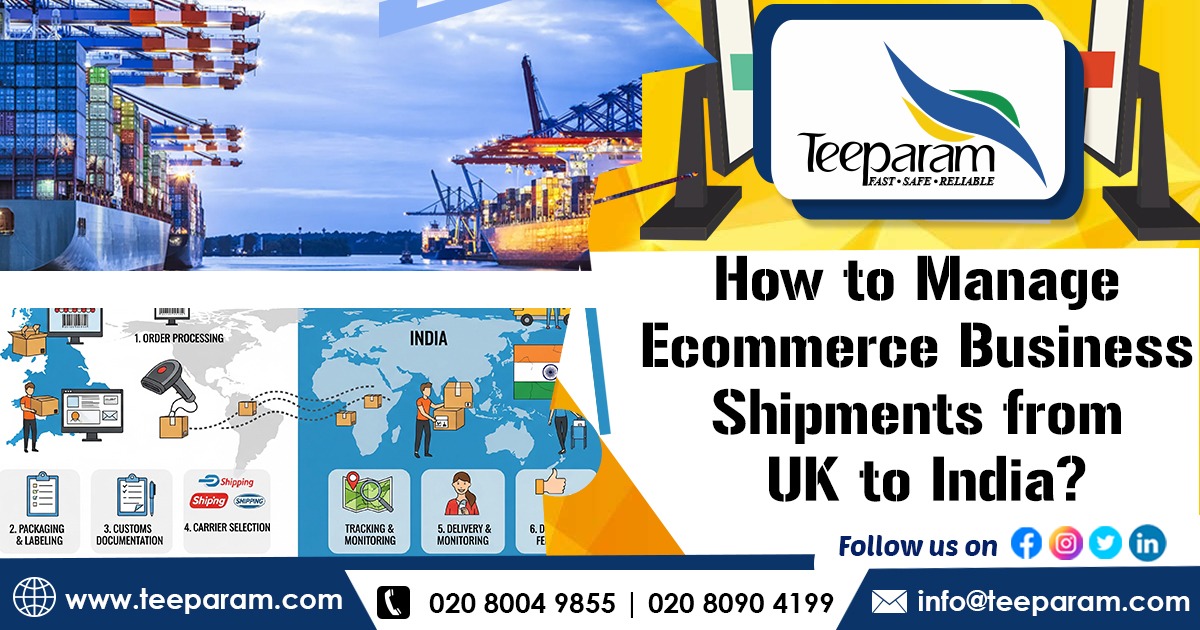
How to Manage E-commerce Business Shipments from the UK to India?

How to Manage E-commerce Business Shipments from the UK to India?

E-commerce companies heavily depend on trusted and effective shipping to thrive in today’s rapidly evolving digital economy. Online sellers seeking to expand their customer base in India must have a well-managed shipping strategy.  E-commerce companies need to learn how to manage shipments efficiently and economically as more Indian customers shop online for goods from abroad.

Key Components Affecting UK-to-India Shipping Cost 

To develop a proper plan and budget, e-commerce sellers need to understand the factors that influence shipping costs. Among the main factors are:

  1. Package Dimensions and Weight

Shipping costs are calculated using the parcel’s actual weight or volumetric weight, whichever is greater. Volumetric weight takes into account the package size, considering that large but lightweight packages do not get overcharged. E-commerce sellers should concentrate on cutting back the extra packaging to save money.

  1. Speed of Delivery

Faster deliveries cost more than a standard delivery. It is important to match shipping speeds with customer needs. Some clients will prefer to wait a few more days rather than pay a higher rate for shipping.

  1. Additional Services

Insurance, real-time tracking, and signature confirmation are some of the important add-ons. Even though they slightly put up the price, they are essential for safeguarding expensive e-commerce items like luxury goods, fashion items, and electronics.

  1. Seasonal Variations

Holiday seasons or major sales events can increase the shipping costs due to the high demand. To prevent delays and extra costs, E-commerce companies should plan their shipments ahead of time.

Selecting the Best Courier Service for Deliveries in E-Commerce

One of the most important steps in handling shipments from online retailers is choosing a suitable courier partner. Businesses should evaluate couriers based on the following criteria when shipping packages to India:

Time of Delivery: Think about the speed at which you would like your clients to receive their orders. Express services are more expensive but faster.

Tracking Features: Both the buyer and the seller can follow the shipment’s path with accurate tracking.

Options for insurance: Guards against damage or loss of priceless or delicate goods.

Customs Support: Customs clearance goes more smoothly when couriers assist with paperwork.

Flexibility in Pickup and Delivery: Door-to-door services, particularly for small and medium-sized businesses, save time and effort.

By working with a courier partner like Teeparam Logistics, businesses benefit from low cost, better speed, and reliability. They will ensure a smoother shipping experience for both sellers and customers.

How to reduce costs in E-commerce Shipping

Online businesses must control expenses without compromising their quality of service. Here are a few tried-and-true methods:

1. Make a plan

Prepare ahead of time to avoid last-minute express shipments. You can select standard, economical delivery options with scheduled shipping.

2. Enhance Packaging

Reduce volumetric weight charges by using packaging that is the proper size. Always use sturdy yet lightweight materials to protect the items without raising shipping costs.

3. Look for Shipping Choices

Never accept just one quote. Search for a variety of options that can enable you to choose the one that best suits your needs in terms of delivery expectations and budget.

4. Consider Bulk Shipping

When shipping several orders to India, it’s usually less expensive to ship them all at once rather than sending each package separately.

  1. Make Use of Digital Tools

Nowadays, many logistics companies offer digital platforms that simplify price comparison, shipment tracking, and document management—all in one location.

Understanding the Customs rules and regulations for UK-to-India Shipments

For many e-commerce businesses, the most challenging part of international shipping is customs clearance. Documentation errors can lead to additional fees or delays. E-commerce vendors need to be aware of:

  1. Accuracy in Documentation

A commercial invoice, packing list, and accurate product information must be included with every shipment.

  1. Items That Are Prohibited and Restricted

Some products may need permits to be shipped into India, while others are prohibited. Before shipping, sellers must review the most recent list of prohibited items.

  1. Taxes and Duties

Depending on the value of the shipment and the type of product, recipients in India might be required to pay customs taxes or duties. Gaining customers’ trust requires being open and honest about these costs.

        4. HS Codes

HS codes provide the customs duty and tax applicable for various products, and the correct Harmonized System (HS) codes are essential. 

How Teeparam Logistics Can Support E-commerce Businesses in the UK

A logistics partner that not only handles shipping but also streamlines the entire process can be very helpful to e-commerce sellers. Teeparam Logistics provides value in the following ways:

1. Reasonably priced and adaptable options

Teeparam Logistics helps companies increase profits while maintaining customer satisfaction by providing affordable solutions that are suited to various shipment sizes and speeds.

2. Tracking in Real Time

Consumers expect to constantly know the status of their orders. Teeparam Logistics gives buyers and sellers peace of mind by providing dependable tracking updates.

3. Easy Clearance of Customs

Teeparam Logistics lowers the possibility of delays at Indian customs by helping with documentation and compliance.

4. Insurance for Peace of Mind

Sellers can ship valuable goods with confidence, knowing they are covered against potential losses thanks to built-in insurance options.

  1. Complete Support

Teeparam Logistics reduces the hassle for e-commerce companies by providing door-to-door service from pickup in the UK to delivery in India.

Digital Efficiency

Teeparam Logistics saves e-commerce sellers a great deal of time by enabling automated documentation, quote comparisons, and shipment management through its digital logistics platform. At a glance, it might look difficult to manage e-commerce shipments from the UK to India, but it is quite easy with the correct preparation and logistics assistance. Businesses can speed up their international deliveries by understanding cost factors, making plans, optimizing packaging, and successfully dealing with customs.

With competitive prices, real-time tracking, customs assistance, and end-to-end service, Teeparam Logistics stands out as a trustworthy partner for online retailers. UK companies can enter the Indian market with confidence thanks to their experience, delivering goods fast and satisfying customers.

Role of AI in improving route planning for Logistics

Role of AI in improving route planning for Logistics

Effective route planning for logistics industry needs to remain competitive, as customers increasingly prefer quicker delivery options. They face challenges such as delays, high fuel costs, and customer dissatisfaction more often. Fortunately, Artificial Intelligence (AI) has the potential to transform the landscape. With the help of AI, route planning for logistics being revolutionized by making it faster, smarter, and more reliable.

By utilizing big data, machine learning, and predictive analytics, AI can help companies plan better routes, reduce delivery times, and save money. How exactly does the AI improve route planning and the many benefits it brings to logistics operations?

Why does logistics need Route Planning?

By route planning, logistics companies can determine the most efficient path for vehicles to deliver goods. It needs to take into account several factors, such as traffic conditions, delivery time windows, vehicle capacity, road restrictions, and fuel consumption.

Route planning often depends on manual input or basic software tools, which are usually time-consuming and less accurate, but AI can eliminate such issues.

How Route Planning Can Be Transformed by Using AI

  1. Automation of Route Planning

AI is capable of handling complex calculations faster than humans or simple software. Systems that use AI automate route planning by analyzing multiple factors at once—like traffic patterns, delivery priorities, weather, and vehicle load.

This makes logistics managers’ work less complicated, as they no longer need to spend hours creating delivery schedules. AI can do this within seconds, offering the most efficient routes with little to no manual work.

  1. Real-Time Traffic Analysis

This is one of the most helpful features of AI. AI accesses traffic data from GPS, sensors, and public traffic feeds and then uses this information to make the best moves for your delivery.

AI can quickly offer alternative routes if there’s an accident or heavy traffic on the planned route. This can make the deliveries fast and keep them on schedule, improving both efficiency and customer satisfaction.

  1. Delay Management through Predictive Analytics

AI is not only helpful in real-time conditions, but it can also predict future problems. AI systems are capable of predicting delays or route disruptions by using historical traffic data, weather forecasts, and delivery trends.

Logistics providers can take proactive steps to reroute vehicles, avoid slowdowns, and keep operations smooth with the help of AI.

  1. Best Route Adjustments

AI is capable of providing a secondary route instantly if a customer changes their delivery address last minute or a road suddenly becomes blocked. It provides dynamic routing while your goods are on the go.

Delivering goods can often face unexpected delays; therefore, flexibility is essential in logistics. Dynamic routing helps cut down wasted time and ensures on-time delivery.

  1. Integration with IoT and Telematics

AI can perform well when connected to IoT (Internet of Things) devices and telematics systems. Sensors connected to vehicles can collect data on engine health, speed, fuel usage, and driver behavior.

These data are then analyzed by the AI in real-time to make smart decisions on selecting the route. For example, AI can reroute a vehicle to a nearby station that is low on fuel. Likewise, if a driver is running out of working hours, AI can adjust the route to stay within legal limits.

  1. Improving Last-Mile Delivery

AI can help with the most difficult and expensive final step of the delivery process by:

  • Providing maximum efficiency to delivery sequences
  • Providing the best time for each delivery
  • Giving drivers clear instructions for multiple stops

This will not only save time and fuel but also ensure packages reach customers fast and on time.

  1. Machine Learning Aids Continuous Improvement

Machine learning over time can improve the AI systems, making them smarter. AI can learn from past deliveries and analyze what worked and what didn’t, then improve its algorithms.

The more you keep using AI for route planning, the better it becomes. As a result, your logistics operations will become more efficient and reliable over time.

What are the benefits of AI-driven route optimization?

  1. Increased efficiency in operations

AI helps to cut down travel time and speed up delivery schedules, resulting in fewer delays, fewer missed deliveries, and improved utilization of vehicles and drivers.

  1. Cost Reduction

AI can eliminate extra mileage and idle time, allowing companies to save money on fuel, vehicle maintenance, and labor. Little improvements in route planning can lead to big savings over time.

  1. Maximum utilization of resources

AI can make sure that every vehicle carries a full load and every delivery person is assigned tasks based on their location and availability. It allows logistics companies to use resources more smartly.

  1. Reduce impact on the environment

Cutting down the mileage reduces the fuel usage. This helps companies to cut down their carbon footprint and support global sustainability goals.

  1. Improved Customer Satisfaction

Customers do not complain if the deliveries are made on time, with live tracking, and with fewer mistakes. If your customers are well satisfied with your service, they will stay loyal and recommend your service to others.

  1. Scalability and Flexibility

Since the AI can adapt easily according to the demands, it will handle more deliveries without lowering the efficiency as your business grows.

  1. Better Decision-Making

Logistics managers can make better business decisions with data-driven insights provided by the AI that help with long-term planning and forecasting.

Now think of a delivery company with 50 vehicles handling hundreds of daily orders in a large city. If they run without any help from AI, the route planning may take more time, resulting in late deliveries and extra fuel costs.

On the other hand, with AI:

  • Routes will be planned in no time.
  • Vehicles can avoid traffic jams automatically.
  • Drivers can make more deliveries in less time.
  • Drop in fuel usage.
  • Can provide accurate delivery time updates to customers.

Automation, intelligence, and adaptability provided by AI are transforming route planning in the logistics industry. Options such as last-minute route changes thanks to real-time traffic analysis by AI enable logistics companies to work smarter.

Nowadays, using AI for route optimization has become a necessity to provide a better service for the growing demand for deliveries and to satisfy the rising customer expectations. Teeparam is also offering other services that includes Money transfer through which you can send money to Sri Lanka and get competitive rates.

      W W W